Gympie Goldfield: How Gold Saved Queensland from Bankruptcy
Discover the fascinating history of Gympie's gold discovery in 1867 that literally saved Queensland from financial ruin, and learn where to prospect today.
Gympie Goldfield: How Gold Saved Queensland from Bankruptcy
In October 1867, a struggling prospector named James Nash made a discovery that would change Queensland’s fate forever. The gold he found at what would become Gympie didn’t just create a new mining town—it literally saved the colony of Queensland from financial collapse. Today, Gympie remains one of Southeast Queensland’s most accessible and historically significant goldfields, offering modern prospectors a blend of rich history, productive ground, and convenient access. This is the story of the goldfield that saved a colony and continues to reward persistent detectorists.
The Crisis: Queensland on the Brink
To understand Gympie’s significance, we must first understand Queensland’s desperate situation in the 1860s. The colony, established in 1859 when it separated from New South Wales, faced severe economic challenges by the mid-1860s.
Economic Catastrophe
The colony’s economy, based primarily on pastoral industries (sheep and cattle), suffered from:
- A devastating drought that decimated livestock
- Falling wool prices on international markets
- Massive debt from ambitious infrastructure projects (particularly railways)
- A severe banking crisis that saw several institutions fail
- Mass unemployment in the capital, Brisbane
By 1867, Queensland was effectively bankrupt. The colonial government struggled to pay public servants, and talk of re-joining New South Wales or even being taken over by the British government circulated. The colony desperately needed something—anything—to revitalize its economy.
The Search for Salvation
Queensland’s leaders looked to gold as a potential savior. Gold had transformed Victoria in the 1850s, and New South Wales had seen significant gold rushes. Queensland had experienced minor gold finds at places like Canoona (near Rockhampton), but nothing substantial enough to create lasting prosperity.
The government offered substantial rewards for significant gold discoveries, hoping to trigger a rush that would bring population, wealth, and economic activity. Prospectors fanned out across the colony, but success remained elusive—until October 1867.
James Nash: The Man Who Saved Queensland
James Nash was an unlikely savior. Born in Sussex, England, in 1834, Nash had come to Australia seeking fortune but had found mainly hardship. By 1867, he was nearly 40 years old, penniless, and working his last prospecting venture before giving up entirely.
The Discovery
On October 16, 1867, Nash was working a creek (later called Nashville Creek) about 160 kilometers north of Brisbane, near a place called One Mile. His prospecting had yielded only small colors of gold, but he persisted, moving up the gully and testing different spots.
Using only a simple gold pan and basic tools, Nash uncovered what would become known as “the nugget that saved Queensland”—actually multiple nuggets and rich alluvial gold. In his first day, he recovered approximately 75 ounces of gold, an extraordinary find.
The Rush Begins
Nash, showing characteristic Australian bush wisdom, kept his find secret while he secured more gold. When he finally traveled to Brisbane to sell his gold and register his claim, the news exploded across the colony. Within days, thousands of fortune-seekers were headed north to what was being called the “Gympie” diggings (from the Aboriginal word “gimpi-gimpi,” referring to a stinging tree common in the area).
The Gympie Gold Rush
The Gympie gold rush was immediate and transformative, unlike anything Queensland had previously experienced.
Population Explosion
From a virtual wilderness, Gympie became a town almost overnight:
- 1867: Virtually unpopulated
- 1868: Population exceeded 2,000
- 1869: Population reached 15,000
- Peak: Over 20,000 people at its height
This made Gympie the third-largest town in Queensland, behind only Brisbane and Toowoomba. The town grew so rapidly that infrastructure struggled to keep pace. Tent cities surrounded the town, and the goldfield extended for miles in every direction.
Economic Impact
The economic transformation was even more dramatic than the population boom:
Immediate Relief: Gold from Gympie provided immediate cash flow into the colonial economy. The Queensland government collected substantial revenue through mining licenses, gold royalties, and general taxation of the resulting economic activity.
Long-term Prosperity: Between 1867 and 1900, Gympie produced over 3 million ounces of gold (approximately 93 tonnes), worth an astronomical sum. This wealth:
- Paid off government debts
- Funded infrastructure projects
- Attracted immigration and investment
- Established Queensland as economically viable
It’s no exaggeration to say that without Gympie’s gold, Queensland might not exist as a separate state today.
Development of Deep Mining
Unlike many Australian goldfields where only alluvial gold was accessible, Gympie’s deep primary deposits required sophisticated mining. Deep leads (ancient buried creek beds) containing rich alluvial gold were discovered beneath layers of basalt and other rock, requiring extensive shaft-sinking and tunneling.
By the 1870s, Gympie had developed into a major deep-mining center with:
- Multiple company mines with sophisticated equipment
- Extensive underground networks (some extending hundreds of feet deep)
- State-of-the-art crushing and processing facilities (for the era)
- Innovative mining techniques that influenced other Queensland goldfields
The Goldfield’s Geography and Geology
Understanding Gympie’s geological setting helps modern prospectors target productive areas.
Geographic Location
Gympie is located approximately 160 kilometers north of Brisbane in Southeast Queensland’s Mary River Valley. The goldfield extends across an area roughly 30 kilometers long (north-south) and 10 kilometers wide (east-west), centered on the town of Gympie.
The goldfield’s proximity to Brisbane and coastal ports was crucial to its development—a stark contrast to remote fields like Palmer River. Supplies could reach Gympie in days rather than months, and gold could be quickly transported to banks and markets.
Geological Setting
Gympie’s goldfield is located in the Gympie Terrane, a complex geological formation featuring:
Primary Gold: Gold-bearing quartz reefs and veins within metamorphosed sedimentary rocks (slates and phyllites). These primary sources are the ultimate origin of Gympie’s gold.
Deep Leads: Ancient buried creek beds containing rich alluvial gold. These “deep leads” were formed millions of years ago when drainage patterns differed from today’s. Later volcanic eruptions covered them with basalt, preserving and concentrating the gold. These leads were particularly rich because they represented gold concentrated over extended periods.
Modern Alluvium: Gold in current creek beds and gullies, continuously being liberated from the primary sources through weathering and erosion.
Laterite Cover: Much of the goldfield has a laterite (weathered rock) cap, within which eluvial gold (gold weathered from primary sources but not transported far) accumulates.
Rock Types and Indicators
Prospectors should recognize these features:
Quartz: White or milky quartz veins are common throughout the goldfield. Many are gold-bearing, particularly those showing iron staining (red, orange, or brown discoloration).
Slate and Phyllite: The dark, often shiny metamorphic rocks that form the bedrock. Gold occurs in quartz veins cutting through these rocks.
Basalt: Dark volcanic rock that caps portions of the goldfield, particularly around One Mile and Monkland areas. The gold-bearing deep leads often occur beneath this basalt.
Ironstone: Iron-rich rocks indicating mineralization. These can be productive detecting targets.
Where to Prospect at Gympie Today
Modern Gympie offers various prospecting opportunities, though much has changed since the 1860s.
Public Fossicking Areas
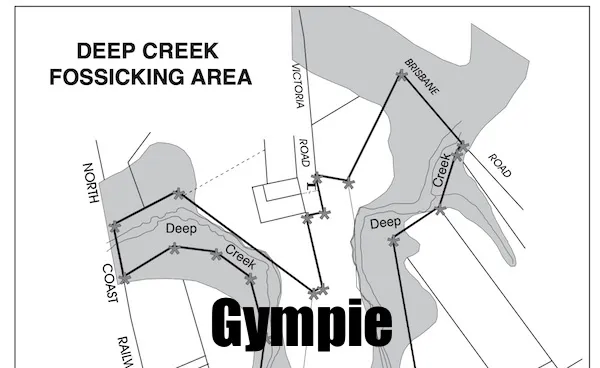
Several designated fossicking areas are open to licensed prospectors:
Amamoor State Forest: Located southwest of Gympie, this area has designated fossicking zones. Alluvial gold can be found in creeks, and eluvial gold occurs on ridges and slopes. Popular with local prospectors.
Lake Borumba: The area around this reservoir (formed by damming Yabba Creek) has gold-bearing ground, though be aware of water level restrictions and access regulations.
Nashville: The area around the original discovery site has some public access areas, though much is now residential or private land.
Historic Working Areas
With appropriate permissions and verified access:
One Mile: The historic township (now essentially a suburb of Gympie) was one of the richest areas. Modern detecting around old workings (on accessible land) can be productive.
Smithfield: Another historic mining center with extensive old workings.
Monkland: North of central Gympie, Monkland had significant production. Some areas are accessible for detecting.
Private Property
Much of the historical goldfield is now private property (farmland, residential areas, or controlled by mining companies). Never prospect on private land without written permission, but many landowners do grant permission to respectful prospectors, particularly if you:
- Approach professionally with written permission requests
- Offer to share finds or a percentage
- Demonstrate respect for property and proper prospecting practices
Creek Systems
Several creeks drain the goldfield:
Nashville Creek: The original discovery site. Access is limited, but upper reaches may have public access points.
Glastonbury Creek: Drains the northern goldfield. Some public access areas exist.
Six Mile Creek: Historically productive, though access is variable.
Always verify current land status and access permissions before fossicking any location. Land tenure has changed significantly since the gold rush era.
Practical Prospecting at Gympie
Access and Facilities
Gympie’s accessibility is one of its major advantages:
Location: Only 160 kilometers (roughly 2 hours’ drive) north of Brisbane on the Bruce Highway Accommodation: Full range from caravan parks to hotels Supplies: Complete shopping, including prospecting equipment at local shops Medical: Hospital and medical facilities in town Fuel and Services: All available
This accessibility makes Gympie ideal for:
- Weekend prospecting trips
- Beginners who want accessible goldfields
- Those without 4WD vehicles (much of the area is accessible via standard roads)
- Families (town facilities nearby)
Equipment Recommendations
For Gympie goldfield prospecting:
Metal Detectors: Both VLF and PI detectors work well. The ground mineralization is moderate—less extreme than remote Western Australian goldfields. Good VLF machines with gold modes (like Minelab Equinox series) can be very effective.
Gold Pans: Creek fossicking can be productive, particularly after floods. A gold pan and classifier are worthwhile additions.
Hand Tools: Standard picks, shovels, and trowels suffice for most detecting.
Gold Characteristics
Gympie gold typically:
- Fine to medium nuggets (0.1-5 grams most common)
- Occasional larger pieces (5-20 grams)
- High purity (often 94-96% pure, approximately 22.5-23 karat)
- Bright yellow color
- Often attached to quartz or ironstone
Very fine gold (less than 0.1 grams) is also common, particularly in creek beds.
Best Times to Prospect
Gympie’s subtropical climate means year-round prospecting is possible, though some periods are preferable:
Best: May through September (dry season, mild temperatures) Good: April, October (shoulder seasons) Challenging: November through March (hot, humid, heavy rain possible, floods can close access)
Summer detecting is possible but requires early morning or late afternoon sessions to avoid midday heat and humidity.
Realistic Expectations
Gympie is well-worked. This is both a challenge and an opportunity:
Challenge: Easily accessible areas have seen extensive detecting over decades. Finding gold requires persistence and sometimes creativity in location selection.
Opportunity: The goldfield is extensive and productive. New gold is constantly being liberated through erosion. After floods, detecting can be particularly rewarding as gold is redistributed. Private property with limited previous access can be very productive.
Most successful Gympie prospectors find small amounts regularly rather than large nuggets occasionally. A day’s detecting might yield 0.1-1 gram if you find gold at all, with occasional better days.
Gympie’s Heritage
Beyond prospecting, Gympie offers remarkable historical heritage:
Historic Sites
Gympie Gold Mining and Historical Museum: Excellent museum covering the rush and mining history.
Woodworks Forestry and Timber Museum: Covers the timber industry that grew alongside mining.
Historic Buildings: Numerous 1870s-1880s buildings remain throughout town, reflecting the gold rush wealth.
Old Workings: Visible throughout the region (though dangerous—never enter old shafts or tunnels).
Cultural Significance
Gympie holds a special place in Queensland’s identity as “the town that saved Queensland.” This recognition includes:
- Regular heritage festivals and commemorations
- Strong local historical societies
- Protected heritage sites
- Tourist infrastructure highlighting gold rush history
Conclusion
Gympie goldfield represents a unique combination: historically significant, geologically productive, and practically accessible. While you won’t find the multi-ounce nuggets that were common in 1867, the goldfield continues to yield finds to patient, persistent prospectors.
More than that, prospecting at Gympie connects you with a pivotal moment in Australian history. Every nugget found is a direct link to the gold that saved Queensland from bankruptcy, that transformed a wilderness into a thriving town, and that literally changed the course of the colony’s future.
Whether you’re a beginner wanting accessible goldfield experience or an experienced prospector appreciating historical significance alongside prospecting potential, Gympie delivers. The James Nash statue in the town center stands as a permanent reminder that one person’s perseverance and a single gold discovery can change the fate of an entire colony.
Gympie’s gold is still there, waiting in the ancient creek beds, weathering from quartz reefs, and accumulating in the red soils that covered these hills long before James Nash made his historic find. Will your detector uncover the next piece of the gold that saved Queensland?