Where to Find Gold Prospecting Locations in Western Australia
Everything you need to know to start metal detecting for gold in Western Australia, from choosing the right equipment to understanding local regulations.
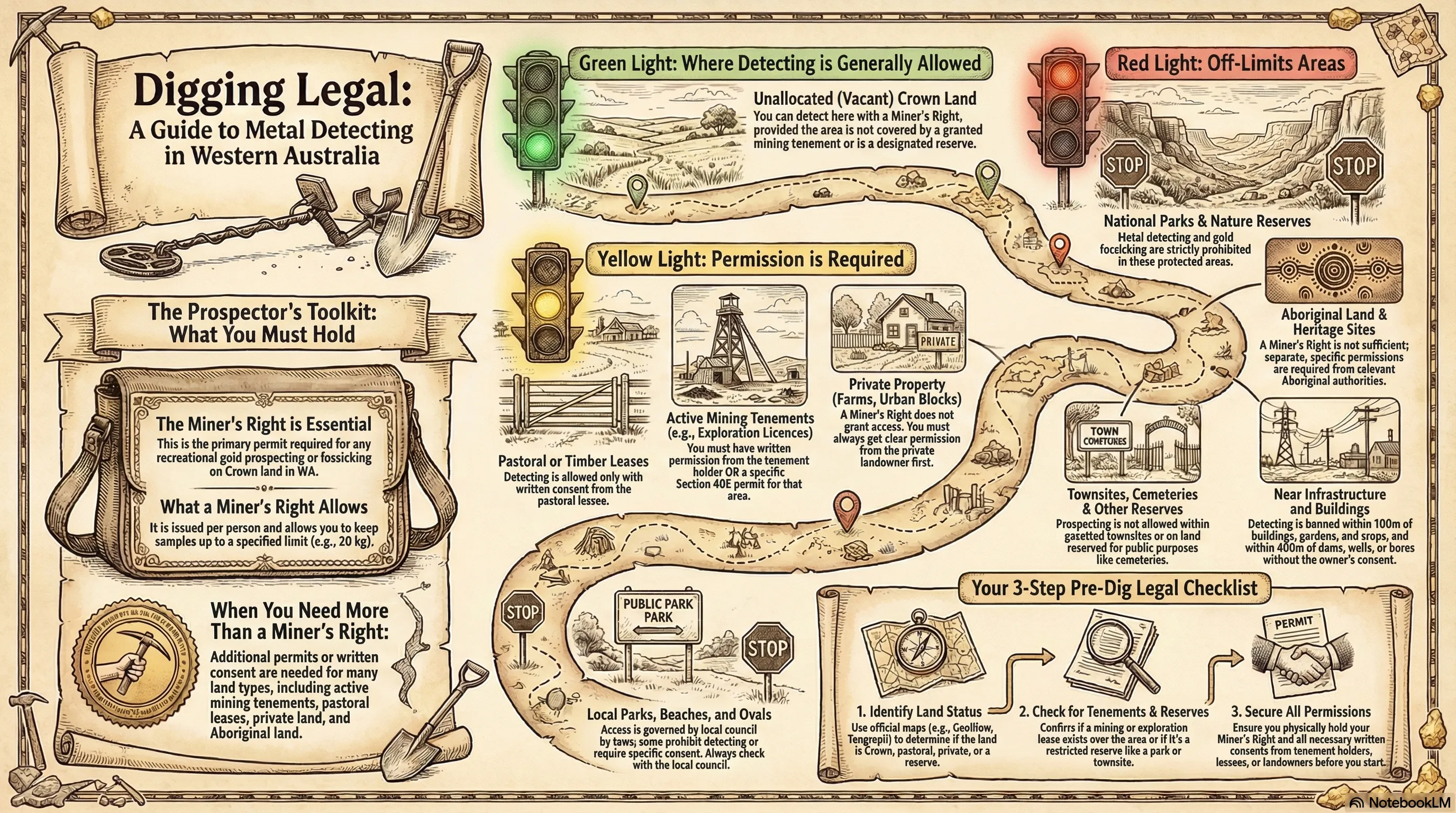
You can legally metal detect for gold in Western Australia if you hold a current Miner’s Right and you are on the correct category of land with any required permissions. The rules are specific to land type, so it helps to think in terms of what is clearly allowed, clearly banned, and “allowed only with extra permission”.
Places you can detect with a Miner’s Right
With a Miner’s Right, you may prospect (including metal detecting) on certain types of Crown land, subject to conditions.
-
Unallocated or vacant Crown land
- You can detect where the ground is not covered by a granted mining tenement or reserved for another purpose.
-
Crown land under pastoral or grazing/timber lease
- Detecting is allowed if the land is not covered by a granted tenement and you have written consent from the pastoral or other lessee.
-
Exploration licences (Section 40E or written consent)
- You may detect on granted exploration licences only if:
- You have written permission from the exploration tenement holder; or
- You hold a Section 40E permit for specific graticular blocks (hand tools only, usually for 3 months).
- You may detect on granted exploration licences only if:
-
Other mining tenements (prospecting, mining leases etc.)
- Detecting is only lawful with written permission from the tenement holder; the Miner’s Right alone is not enough.[
Places you cannot detect (even with a Miner’s Right)
Some land categories are off-limits to recreational detecting unless special, separate permissions exist.
-
National parks and nature reserves
- Metal detecting and gold fossicking are not allowed in WA national parks or nature reserves.
-
Townsites and other classified reserves
- You cannot prospect within gazetted townsites, on cemeteries, or other classified reserves.
-
Aboriginal land and heritage sites
- Separate permissions from relevant Aboriginal corporations/authorities and compliance with heritage laws are required; general Miner’s Rights do not override this.
-
Around houses, crops and water infrastructure
- Detecting is prohibited:
- Within 400 m of the outer edge of water works, races, dams, wells or bores.
- Within 100 m of land under crop, gardens, orchards, vineyards, plantations, airstrips, airfields, yards or stockyards, and occupied land with substantial buildings, unless you have the landowner’s consent and any required permit.
- Detecting is prohibited:
Private property, farms and urban detecting
For non-gold or general relic/coin detecting, land access law still applies: you must have the legal right to be on the land.
-
Private freehold land (including farms, houses, urban blocks)
- A Miner’s Right does not automatically give access; you must obtain the landowner’s clear permission to enter and detect.
- A separate “Permit to Enter” may be required where indicated by the department for private property used for agriculture.
-
Beaches, parks, ovals and urban reserves
- There is no single statewide rule; many local councils have by-laws governing detecting in parks, ovals and riverbanks, and some prohibit it or require consent.
- Beaches are often tolerated for coin/relic detecting, but fenced dune rehabilitation areas and signed exclusions must be respected, and local council rules still apply.
What you must hold
Even though people talk about a “metal detecting permit”, for gold and mineral detecting in WA the key instrument is the Miner’s Right.
-
Miner’s Right
- Required for recreational gold prospecting and fossicking on Crown land in WA, including metal detecting.
- Low cost, issued per person, and allows you to keep up to a specified amount of samples or specimens (e.g. up to 20 kg per person under current guidance).
-
When extra permits or permissions are needed
- Section 40E permit for detecting on granted exploration licences without direct written permission from the holder.[4][3]
- Written consent from:
- Tenement holders, when on their granted leases.
- Pastoral lessees, when on pastoral leases.
- Private landowners, for freehold land.
- Relevant Aboriginal bodies, for Aboriginal land or where heritage applies.
How to check if a spot is legal
In practice, legal detecting in WA comes down to confirming three things for each location.
-
1. Land status
- Identify if it is unallocated Crown land, pastoral lease, freehold, reserve, national park, or tenemented land using official mapping and title systems.
-
2. Tenure and reservations
- Confirm whether a mining or exploration tenement exists over the area, and whether it is reserved as a park, nature reserve, townsite, cemetery or other restricted category.
-
3. Permissions in hand
- Ensure you hold:
- A current Miner’s Right.
- Any required Section 40E permit.
- All necessary written permissions from tenement holders, pastoral lessees, private landowners and relevant Aboriginal entities.
- Ensure you hold:
If you say the type of detecting you have in mind (goldfields detecting on Crown land vs. urban coin/relic hunting) and whether you’re using tenure maps already, more targeted field examples can be sketched for typical WA scenarios.