Menzies
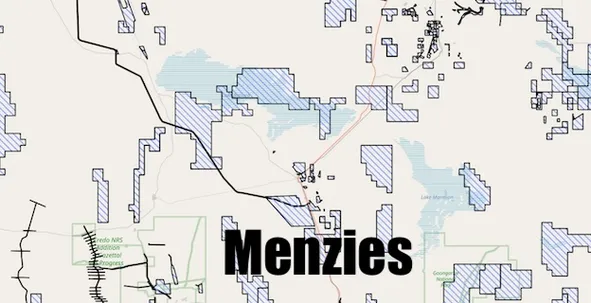
Gold Prospecting Location around Menzies
Looking for a place to give gold prospecting a try around Menzies?
● Download a simple map that shows areas where you can go and the major roads to those locations.
● Each map is custom made, showing the absolute latest information for any given area.
● Put it on your phone, tablet or computer. No special software required and works without internet connections.
Get This Map
Enter your email and we will create and email you the latest,high-resolution map as a PDF.
We respect your privacy. Your email will not be sold or traded to others.
Named after prospector Leslie Robert Menzie, this town was built on one of the richest gold discoveries in the Eastern Goldfields. The Lady Harriet Gold Mine was first discovered in September 1894, but it was Menzie's subsequent discovery of the Lady Shenton and Florence leases on October 1, 1894, that sparked a major rush.
By 1900, Menzies boasted a population of approximately 10,000 with thirteen hotels and two breweries, making it one of the largest towns in the goldfields. While the gold rush lasted only about ten years, Menzies retains its pioneering character with numerous historic buildings and remains a base for modern prospecting activities.
The first gold lease in what would become Menzies was the Lady Harriet Gold Mine, discovered by J. Brown, George Kirby, and Charles Jackman in September 1894. This initial discovery attracted attention to the region.
American miner Leslie Robert Menzie arrived in late 1894 to prospect the area. On October 1, 1894, he made a significant discovery that was registered as two separate leases - the famous Lady Shenton mine and the Florence mine. These proved to be spectacularly rich finds.
A major gold rush followed Menzie's discovery, and the booming town of Menzies was officially gazetted on August 16, 1895. The town grew rapidly, and by 1900 it had reached a population of approximately 10,000 people, making it one of the largest settlements in the goldfields.
At its peak, Menzies supported thirteen hotels, two breweries, a stock exchange, and numerous businesses. The gold rush lasted for about ten years, but by 1905 most miners had left for other fields as the easily accessible gold was exhausted. Today, Menzies is a small town with a rich history, serving prospectors exploring the surrounding goldfields.
Common Questions
Who was Leslie Robert Menzie? ▼
Leslie Robert Menzie was an American prospector who discovered the rich Lady Shenton and Florence gold leases on October 1, 1894. His discovery sparked a major gold rush and the town was named in his honor (with the spelling slightly altered to Menzies).
How large was Menzies during the gold rush? ▼
At its peak around 1900, Menzies had a population of approximately 10,000 people with thirteen hotels, two breweries, and extensive commercial infrastructure. This made it one of the largest towns in the Eastern Goldfields at the time.
What was the Lady Shenton mine? ▼
The Lady Shenton was one of two major gold mines discovered by Leslie Menzie on October 1, 1894. It proved to be an extremely rich deposit and was one of the main drivers of Menzies' spectacular growth during the gold rush era.
Can you still prospect for gold around Menzies? ▼
Yes, the Menzies area remains popular with recreational gold prospectors. The extensive historical workings and gold-bearing geology mean nuggets are still regularly found. Many detectorists visit the area, which is accessible and has numerous prospecting sites.