Norseman
Gold Prospecting Location around Norseman
Looking for a place to give gold prospecting a try around Norseman?
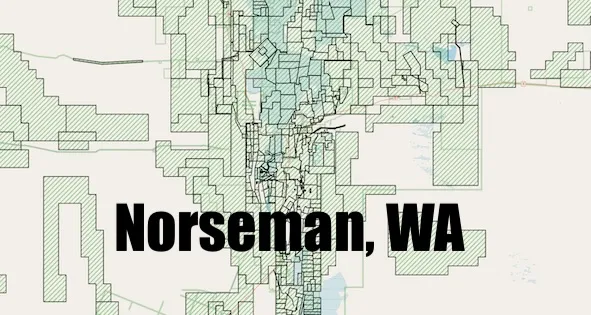
● Download a simple map that shows areas where you can go and the major roads to those locations.
● Each map is custom made, showing the absolute latest information for any given area.
● Put it on your phone, tablet or computer. No special software required and works without internet connections.
Get This Map
Enter your email and we will create and email you the latest,high-resolution map as a PDF.
We respect your privacy. Your email will not be sold or traded to others.
Norseman has one of the most charming gold discovery stories in Australian history. In July 1894, prospector Laurie Sinclair's horse, named Hardy Norseman, pawed at the ground overnight and uncovered quartz laced with gold. This serendipitous discovery led to one of Western Australia's richest goldfields.
The town became the second richest goldfield in Western Australia and is home to Australia's longest continuously operating gold mine. Located at the southern end of the Norseman-Wiluna Greenstone Belt, it remains an important mining center and popular prospecting destination.
Gold was first discovered near the current town location in 1892, about 10-22 km south at Dundas. The Dundas Field was proclaimed in August 1893, but this initial discovery was soon eclipsed by a more significant find.
In July 1894, Laurie Sinclair's horse, Hardy Norseman, made the legendary discovery that would give the town its name. Sinclair had tethered his horse to a tree overnight, and the next morning noticed it had pawed into the ground, uncovering gold-bearing quartz.
Laurie Sinclair, his brother George, and Jack Alsopp registered the reef on August 13, 1894. By January 1895, more than 200 miners were working the goldfield, and the town of Norseman was officially gazetted in May 1895.
The Norseman Gold Mine became renowned as Australia's longest continuously operating gold mine. The town developed rapidly with substantial infrastructure including hotels, banks, a railway connection, and processing facilities. The mine has produced millions of ounces of gold over its 130-year history.
Common Questions
How did Norseman get its name? ▼
Norseman is named after the horse that discovered gold here. In July 1894, prospector Laurie Sinclair's horse, Hardy Norseman, pawed at the ground overnight and uncovered gold-bearing quartz. This led to the discovery of one of Western Australia's richest reefs.
Is the Norseman Gold Mine still operating? ▼
The Norseman Gold Mine has been Australia's longest continuously operating gold mine, though operations have varied over the years. The mine has produced millions of ounces since 1894 and continues to be worked intermittently depending on gold prices and mining conditions.
What makes Norseman good for prospecting? ▼
Norseman lies at the southern end of the Norseman-Wiluna Greenstone Belt, a geological structure rich in gold deposits. The area has extensive historical workings and continues to yield gold nuggets for modern detectorists, particularly in the surrounding bush.
When was the town of Norseman officially established? ▼
The town of Norseman was officially gazetted in May 1895, following the gold discovery in July 1894. By January 1895, more than 200 miners were already working the goldfield, prompting the formal establishment of the townsite.