Peak Hill
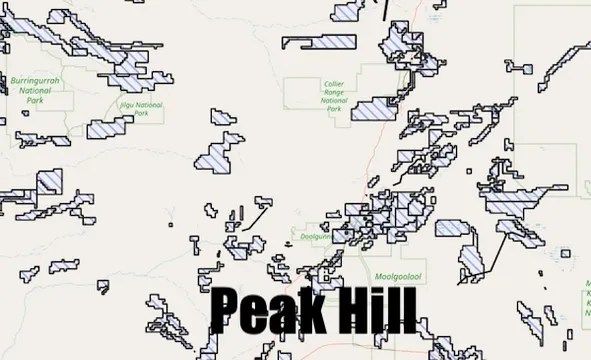
Gold Prospecting Location around Peak Hill
Looking for a place to give gold prospecting a try around Peak Hill?
● Download a simple map that shows areas where you can go and the major roads to those locations.
● Each map is custom made, showing the absolute latest information for any given area.
● Put it on your phone, tablet or computer. No special software required and works without internet connections.
Get This Map
Enter your email and we will create and email you the latest,high-resolution map as a PDF.
We respect your privacy. Your email will not be sold or traded to others.
Gold was discovered at Peak Hill by William John Wilson in 1892, sparking the development of one of the Murchison's significant goldfields. The townsite was officially gazetted in 1897, and by 1900 the town had a population of 800 with a post and telegraph office, Warden's court, school, Miners' Institute, and a State battery.
The gold mine produced an impressive 270,000 ounces of gold until 1913. After declining to a ghost town in the 1970s with only a few remaining residents, activity resumed in the 1980s, producing around 650,000 ounces (18.4 metric tons) of gold. Though the mine became dormant again in the 2000s, Peak Hill's remarkable production record demonstrates the wealth of this Murchison goldfield.
Gold was discovered at Peak Hill in 1892 by William John Wilson. His discovery sparked interest in the area, and prospectors moved in to explore and develop the goldfield. The early finds proved substantial enough to warrant establishing a permanent settlement.
The townsite was officially gazetted in 1897, five years after the initial discovery. By 1900, Peak Hill had developed into a proper town with a population of 800, featuring a post and telegraph office, Warden's court, school, Miners' Institute, and a State Battery to process ore.
The gold mine operated continuously through the early 1900s, producing an impressive 270,000 ounces of gold by 1913. This substantial production made Peak Hill one of the more successful goldfields in the Murchison region during the early 20th century.
After World War I, declining gold prices and exhausted shallow deposits led to the town's decline. By the 1970s, Peak Hill had been reduced to a ghost town with only a few remaining residents. However, rising gold prices and modern mining technology sparked a revival in the 1980s. The mine was reactivated and produced an additional 650,000 ounces (18.4 metric tons) of gold during this period. The mine became dormant again in the 2000s, but Peak Hill's total production of nearly one million ounces demonstrates the richness of this Murchison goldfield.
Common Questions
When was gold discovered at Peak Hill? ▼
Gold was discovered at Peak Hill in 1892 by William John Wilson. The townsite was officially gazetted in 1897, and by 1900 it had grown to a population of 800 with substantial infrastructure including a State Battery.
How much gold was produced at Peak Hill? ▼
Peak Hill produced 270,000 ounces of gold from 1892 to 1913. After reactivation in the 1980s, the mine produced an additional 650,000 ounces (18.4 metric tons), bringing total production to nearly one million ounces of gold.
Why did Peak Hill become a ghost town? ▼
After World War I, declining gold prices and the exhaustion of easily accessible ore led to Peak Hill's decline. By the 1970s it had become a ghost town with only a few residents, though it was successfully revived in the 1980s with modern mining methods.
Is there mining at Peak Hill today? ▼
The mine became dormant again in the 2000s after the successful 1980s-2000s revival. The area may still attract occasional prospecting activity, though there is no large-scale commercial mining currently operating. The site remains historically significant for its impressive production record.